Australians know about EVs. Fewer support them.
Nine in ten Australians (91%) had heard something about electric vehicles, yet fewer than half (45%) said they personally supported buying one, according to the Clean Energy Solutions Index 2025. The gap was not driven by ideology, but by practical concerns about battery reliability, driving range and cost.
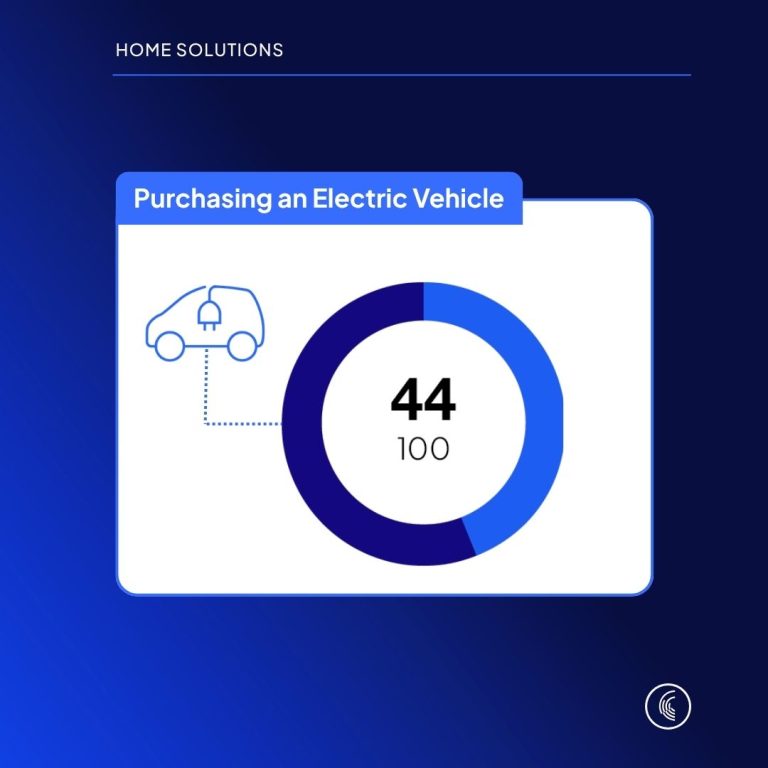
The Clean Energy Solutions Index measures Australians’ deep support for 11 clean energy solutions, based on a national survey of more than 3,000 people. Electric vehicle purchase scored 44 out of 100 in 2025, the lowest score in the Index and 37 points below rooftop solar at 81.
A low score is easy to misread as rejection. The data suggested something more specific: Australians were not unaware of EVs, and they were not hostile to them. They were weighing them up, and the sums were not yet adding up.
Awareness runs well ahead of intent
Share of respondents, by statement
Source: CESI 2025
That consistency mattered. For most solutions in the Index, personal support ran ahead of willingness to talk positively. For EVs, every measure hovered around the same mark, which suggested opinion had settled into a genuine wait-and-see position rather than enthusiasm or firm opposition.
What did CESI 2025 find about EV support?
The Index score is a composite of four measures, and for EVs the four sat in a remarkably tight band:
- 45% personally supported buying an electric vehicle
- 44% agreed it was good for Australia
- 45% believed people in their local community would support it
- 43% said they would talk positively about it to family and friends
That consistency mattered. For most solutions in the Index, personal support ran ahead of willingness to talk positively. For EVs, every measure hovered around the same mark, which suggested opinion had settled into a genuine wait-and-see position rather than enthusiasm or firm opposition.
Awareness was never the problem
CESI 2025 asked what people had heard about each solution. For EVs, only 9% of Australians said they had heard nothing at all. Awareness was close to universal.
What people heard, however, was the most contested of any solution in the Index. 37% had heard both positive and negative things about EVs, the highest mixed reading across all 11 solutions, while 20% had heard mainly negative things and 23% mainly positive.
This is the heart of the awareness gap. Across the Index, CESI found that support strengthened when positive noise strongly outweighed negative. Rooftop solar, where 48% had heard mainly positive things, scored 81. EVs, where the noise was split almost evenly, scored 44. Australians had plenty of information about EVs. What they lacked was a settled, positive picture.
Why the gap? Practical concerns, not ideology
The reasons non-supporters gave pointed to function, not politics. Among those opposed to buying an EV, the leading barriers were:
- Battery reliability and replacement concerns: 61%
- Range limitations: 59%
- Too expensive: 53%
Notably, safety concerns did not feature prominently as a barrier to EVs, unlike home batteries, where 52% of opponents cited risks. The EV hesitation read as a practical question: will this work for my driving, and what will it cost me over time?
Supporters answered with equally practical logic. 56% cited environmental benefit, 53% said EVs save money on petrol and are cheaper to run, and 52% pointed to reduced emissions. Both sides of the EV question were doing the same thing: weighing up whether the technology works for them. This pattern of household economics shaping support ran right across the Index, as we explored in why household economics are shaping clean energy support in Australia.
How many EVs in Australia?
CESI 2025 found that 5% of Australians said they had an electric vehicle, while more than one in three (38%) said they had considered one.
That consideration figure is the most underappreciated number in the EV story. A 33-point gap between consideration and ownership suggested a large group of Australians who were open to an EV but had not yet been convinced on reliability, range or price. The gap looked less like a ceiling on demand and more like a queue of undecided buyers waiting for their practical questions to be answered.
Who is buying electric cars?
CESI 2025 suggested the early adopters were households for whom the practical equation already worked: people motivated by environmental benefit and lower running costs, who had weighed the barriers and found them manageable. Generational patterns added another layer to that picture, which we examined in from concern to consensus: a generational experience of clean energy solutions.
For everyone else, the data indicated the path to broader uptake ran through the three named barriers. Confidence in battery longevity, reassurance on range, and a purchase price that competes with petrol equivalents appeared to be the conditions under which consideration would convert to ownership.
Conclusion
The awareness gap reframes the lazy narrative that Australians do not want EVs. CESI 2025 suggested they knew about them, a third had considered one, and their hesitations were specific and answerable. Later this year, CESI 2026 will show whether the noise around EVs has shifted, whether consideration has grown, and whether the most contested solution in the Index has begun to settle. Explore the EV data in detail on the CESI dashboard.
91% of Australians had heard something about electric vehicles, but only 45% personally supported buying one. The gap was practical, not ideological: battery reliability (61%), range (59%) and cost (53%) were the barriers named, while safety barely featured.
Source note:
Findings are based on the Clean Energy Solutions Index 2025, developed by 89 Degrees East in collaboration with Boundless Earth. Findings draw on a national survey of 3,162 Australian citizens conducted 3 to 18 March 2025, weighted to be representative of the adult population by age, gender and state. See our disclaimer and citation guidance for reuse.