Electric vehicles are an outlier in the Clean Energy Solutions Index. In 2025, they scored 44 out of 100, making them the lowest-rated of the 11 solutions measured and well below the national overall one-number support score of 60.
That score reflects more than general approval. It combines measures of personal support, perceived national benefit, perceived community support and willingness to advocate (Find out more about the index here).
By comparison, other clean energy solutions have moved much further into the mainstream. Rooftop solar scores 81, home batteries 72, and solar farms 68.
That gap reflected a clear reality. In 2025, EVs had not yet achieved the same level of familiarity, confidence or everyday relevance as other technologies.
But that picture is potentially poised to shift.
As petrol prices rise and global oil markets become more uncertain, more Australians are taking a fresh look at EVs. Recent reporting shows a clear lift in consumer interest during fuel price spikes, with analysts pointing to a strong link between higher petrol prices and increased EV demand.
We’ll be fascinated to see what the results will be in the 2026 version of the Index, which will be released later in the year. Do these forces shape a more favourable view of EVs? Keep an eye out.
EVs lag on deep support
The 2025 Clean Energy Solutions Index was developed by 89 Degrees East in collaboration with Boundless, and shows that Australians broadly support clean energy. The national score sits at 60 out of 100.
But, at a score of 44 EVs sit well below that average.
This lower score is consistent across all four components of support:
- Personal support: 45%
- Seen as good for Australia: 44%
- Perceived community support: 45%
- Willingness to advocate: 43%
The barriers are practical, not ideological
The reasons behind this lower support are clear in the data.
In 2025, Australians were not rejecting EVs on environmental grounds. A majority (56%) supported EVs because they are better for the environment.
They also recognised a practical benefit: 53% say EVs are cheaper to run.
Instead, resistance was driven by other practical concerns:
- 61% cited battery reliability and replacement concerns
- 59% pointed to range limitations
- 53% said EVs are too expensive
EVs are not facing a values problem. They are facing a confidence and usability problem.
In contrast, highly supported solutions such as rooftop solar offer clear, visible and immediate benefits at the household level. It’s likely because four million Australian households are already familiar with the benefits of using the power of the sun to lower energy bills. EVs have not yet reached that level of normalisation.
Interest is rising as fuel costs increase
While deep support was low in 2025, behaviour may soon be shifting.
Rising petrol prices are prompting more Australians to reconsider EVs. Recent reporting points to a surge in consumer interest and enquiries during fuel price spikes, as households reassess the long-term cost of driving. NRMA alone reported a 15% increase in EV insurance quotes in just two weeks of March, compared to February 2026, and a surge of 56% on the previous March [Source: IAG].
There is also strong evidence of a structural link. International analysis suggests that for every 1% increase in petrol prices, EV sales can rise by around 0.85%, highlighting how sensitive demand is to fuel costs [Source: ABC news, 8/3/26].
This aligns closely with 2025 CESI findings, which can be found on on our interactive dashboard:
- only 5% of Australians currently own an EV
- but 38% have considered purchasing one
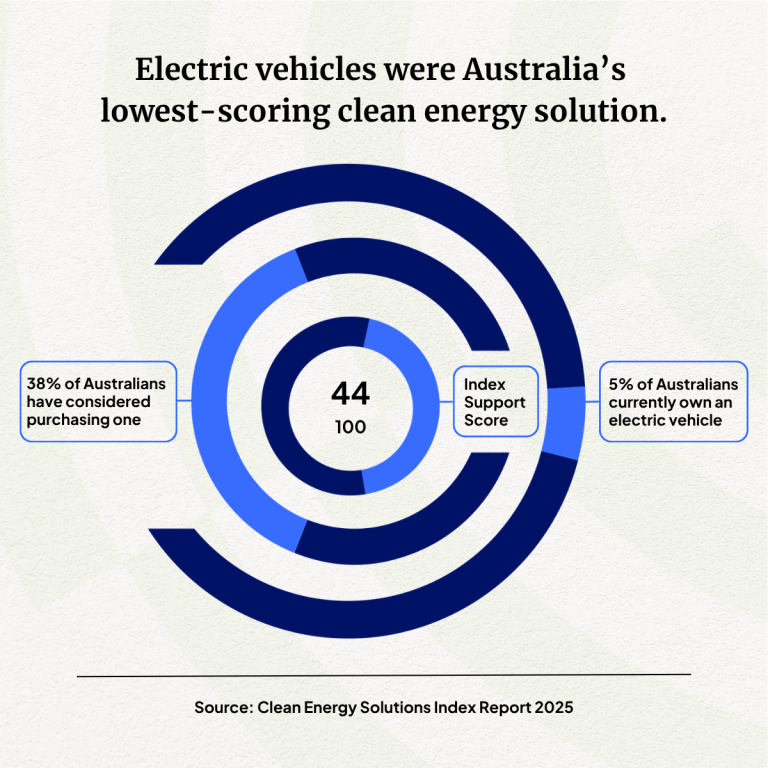
This shows that interest in EVs already exists, but has been constrained by practical concerns. Rising fuel costs are now acting as a trigger, pushing more Australians from passive consideration into active evaluation.
From low support to shifting conditions
- familiarity
- clear economic benefit
- visible community adoption
Conclusion
In the 2025 Clean Energy Solutions Index, electric vehicles stood apart as the lowest-supported solution. The reasons were clear: while many Australians recognised their environmental benefits and lower running costs, practical concerns around price, range and battery reliability continued to weigh heavily.
What happens next is the more interesting question. Since this data was collected, rising petrol prices and growing attention to the long-term cost of driving may be starting to shift the conversation.
As we rerun CESI in the coming months, we will be watching closely to see what has changed.
For more information, the 2025 report can be found here, or a the publicly available data can be accessed via our interactive dashboard here.
“The next wave of data will show whether EVs remain an outlier, or whether changing economic conditions are beginning to build the familiarity, confidence and everyday relevance needed for deeper support.”
– Dr Rebecca Huntley.
Source note:
Findings are based on the Clean Energy Solutions Index 2025, developed by 89 Degrees East in collaboration with Boundless, which measures Australians’ deep support for 11 clean energy solutions.